
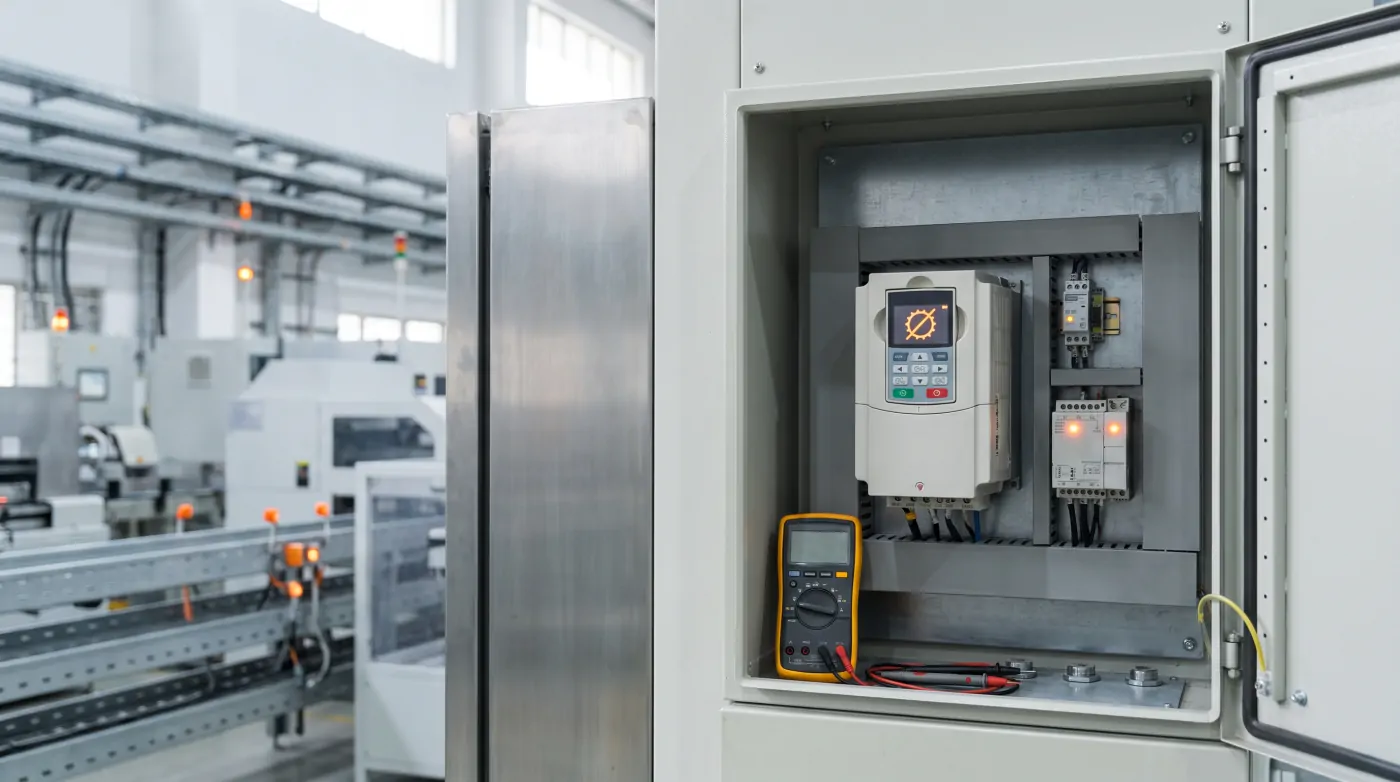
A variable frequency drive (VFD) trips to protect itself, the motor and the process. The fault code on the keypad is the drive telling you which protection operated. Every manufacturer uses its own codes — Siemens, ABB, Delta, Danfoss, Yaskawa and others name them differently — but the underlying faults are the same physics on every drive. Understanding that physics is what turns a two-day breakdown into a twenty-minute fix.
This guide covers the faults we see most often on plant floors in Gujarat, what usually causes them, and a safe order to check things in.
Safety first: the DC bus capacitors inside a VFD stay charged for several minutes after the supply is switched off. Isolate, lock out, wait for the time printed on the drive (often 5–15 minutes) and confirm the DC bus is discharged with a meter before touching terminals.
Before You Reset: Record the Fault
Most drives store a fault history with the time, output frequency, current and DC bus voltage at the moment of the trip. Note these before resetting. A trip at 2 Hz during acceleration points to a very different cause than the same code at 50 Hz under steady load.
Also note when it happens:
- During acceleration
- During deceleration or stopping
- At constant speed
- At start-up, before the motor turns
- Randomly, or at the same time every day
Overcurrent (OC, F0001-type faults)
The drive measured output current above its hardware limit — usually around 200% of rated current, for microseconds.
Overcurrent during acceleration usually means the acceleration ramp is too short for the load inertia, the torque boost is set too high, or the motor is starting into a mechanically jammed load.
Overcurrent at constant speed points to a sudden load change (a jam, a conveyor overload, a pump drawing air) or an intermittent short in the motor or cable.
Overcurrent immediately on start often means a short circuit or earth fault in the motor cable or motor winding, or a failed IGBT in the drive's output stage.
What to check:
- Disconnect the motor cable at the drive output and run the drive with no load. If it still trips, the drive's output stage is suspect.
- Megger the motor and cable (motor disconnected from the drive) — insulation resistance should be well above 1 MΩ; a healthy LV motor is usually in the hundreds of megohms.
- Check motor nameplate data entered in the drive (voltage, current, frequency, speed, power) — wrong data spoils the motor model in vector mode.
- Increase the acceleration time and see whether the trip moves or disappears.
DC Bus Overvoltage (OV)
The DC bus voltage rose above the trip threshold — roughly 800–850 V DC on a 415 V drive. This almost always happens during deceleration: the motor is being driven by the load's inertia and acts as a generator, pushing energy back into the DC bus.
Common causes and fixes:
- Deceleration time too short for a high-inertia load (fans, centrifuges, flywheels). Lengthen the ramp.
- No braking resistor on an application that genuinely needs fast stops. Add a correctly sized braking chopper and resistor.
- Overhauling loads such as cranes, hoists and downhill conveyors need a braking resistor or a regenerative drive.
- High supply voltage or switching transients. Measure the incoming voltage at different times of day.
Many drives have an "overvoltage controller" or "DC bus voltage regulation" function that automatically extends deceleration. It prevents the trip but makes stopping times longer, which may not be acceptable.
DC Bus Undervoltage (UV) and Supply Faults
The DC bus fell below its minimum level. Look at the supply: voltage dips, a loose incomer connection, a blown fuse on one phase, or a weak DG set during changeover. In plants with frequent grid interruptions, consider the drive's kinetic buffering or "flying restart" function so the motor can catch a spinning load after a short dip instead of tripping.
Input phase loss is related — one supply phase is missing or badly unbalanced. Check fuses, contactors and terminal tightness on the drive input.
Motor Overload (OL) and Drive Overload
Overload trips are thermal, not instantaneous. The drive calculates that the motor (or the drive itself) has been carrying more than rated current for too long.
- Confirm the motor rated current is set correctly in the drive.
- Check whether the mechanical load has increased — worn bearings, a dragging brake, a blocked impeller, a belt that is too tight.
- At low speed, a self-cooled motor loses its fan cooling. Constant-torque loads running below roughly 50% speed for long periods may need a separately ventilated motor.
Earth Fault / Ground Fault (GF)
Current is leaking to earth somewhere between the drive output and the motor. Causes include damaged cable insulation, moisture in the motor terminal box, a failing winding, or water in cable trenches.
Test the motor and cable insulation separately with a megger (always with the drive disconnected — a megger will damage the drive's electronics). In humid seasons, a winding that tests marginal may need drying out before it is returned to service.
Overtemperature (OH)
The drive's heatsink is too hot. Clean the heatsink and fans, check that the cooling fan actually runs, confirm panel ventilation or the panel AC is working, and make sure the drive is not installed above another heat source. Dust from textile and cement plants is a frequent cause in Gujarat.
Communication and Encoder Faults
On drives controlled over PROFINET, PROFIBUS, Modbus or EtherNet/IP, a "fieldbus fault" may simply mean the PLC stopped sending a watchdog signal. Check network cables, connectors and switch ports before suspecting the drive. Encoder faults on closed-loop drives are often caused by unshielded or badly earthed encoder cables running next to motor power cables.
Installation Practices That Prevent Most Trips
- Use screened, VFD-rated motor cable with the screen terminated 360° at both ends.
- Keep motor cables separate from control and communication cables.
- Size the drive on motor current, not just kW, and allow for overload duty.
- Add output reactors or dV/dt filters for long motor cable runs.
- Keep a written record of every parameter change.
When to Call a Specialist
If a drive trips on overcurrent with the motor disconnected, shows physical damage, smells burnt, or keeps tripping after the basic checks above, stop resetting it. Repeated resets on a failing output stage can destroy IGBTs and turn a repair into a replacement.
Kamakshi's engineers carry out VFD setup and commissioning and AC & DC drive repair across Ahmedabad and Gujarat. Send the fault code, drive make and a photo of the nameplate on WhatsApp and we will tell you what to check first.
Further Reading
- VFD vs Soft Starter: Which Is Right for Your Motor?
- VFD Energy Saving in Industrial Plants
- Motor Protection Relay Types
Related Articles
Explore more technical guides from our automation knowledge base.