
Why SCADA Is More Than a Screen Package
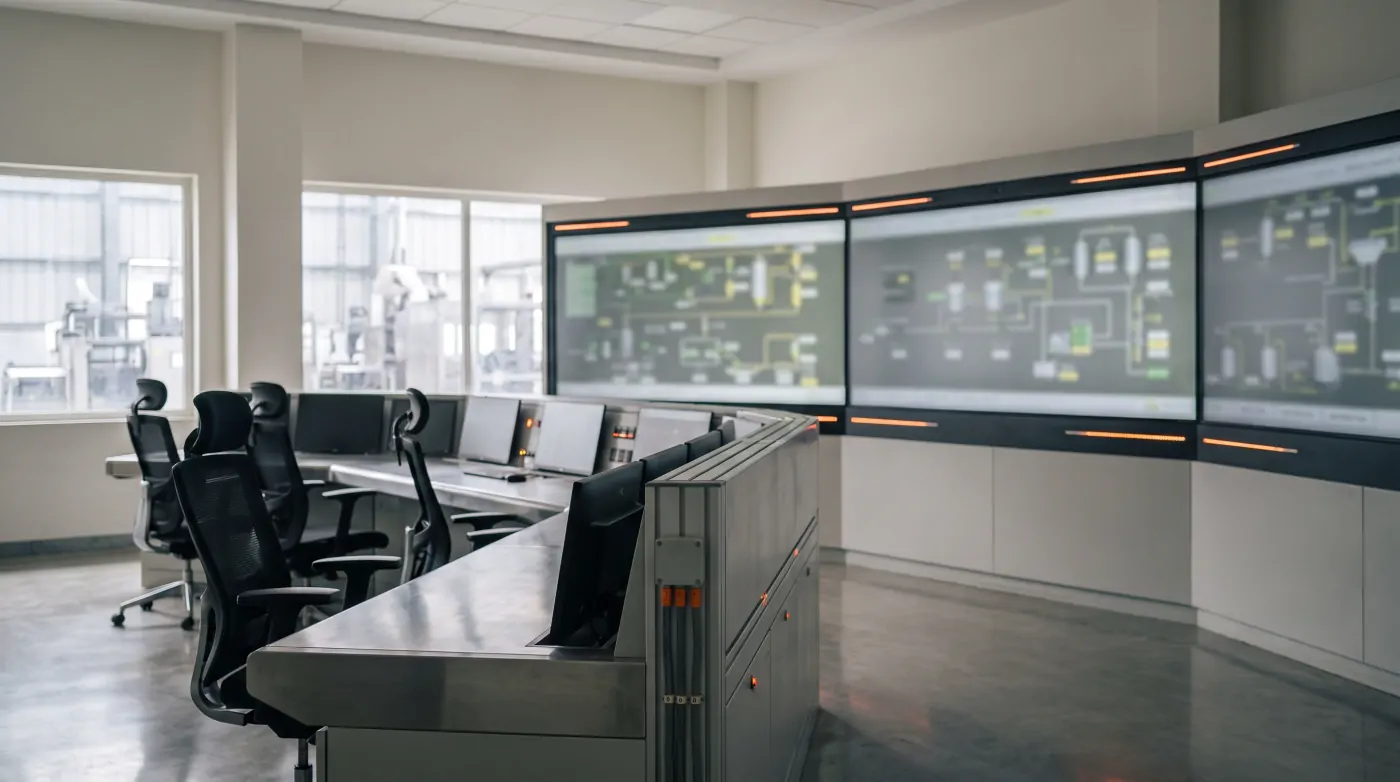
A SCADA platform becomes valuable when it connects plant data, alarms, trends, reports, and operator actions into one coherent operating environment. The goal is not simply to draw machine graphics. The goal is to make production status, utility consumption, faults, and process deviations visible quickly enough for action.
In many plants, SCADA is the layer that turns isolated machine controllers into a monitored production system. Operators gain live visibility, maintenance teams gain diagnostics, engineers gain historical data, and management gains performance reporting. Those outcomes depend on architecture, data quality, and alarm design far more than visual styling alone.
The strongest projects treat SCADA as an operational platform that must support troubleshooting, reporting, maintenance, and future expansion from the start.
Architecture and Communication Planning
Good SCADA architecture starts with device inventory, protocol mapping, network design, and tag structure. PLCs, VFDs, temperature controllers, analyzers, and energy meters must all be integrated with clear naming, scaling, and polling strategies. If those decisions are left until commissioning, the project often becomes fragile and difficult to maintain.
Polling rates should reflect process criticality. Fast-changing control data may need short scan intervals, while slow utility values can be updated less frequently. Network segmentation, switch planning, and remote access controls should also be designed deliberately to protect both performance and security.
Plants standardizing machine control first usually benefit from reviewing PLC Programming Basics for Industrial Automation, because consistent PLC naming and diagnostics make SCADA implementation much cleaner.
Alarms, Historian, and Operator Confidence
Alarm quality is one of the clearest indicators of SCADA maturity. A platform that floods operators with low-value alarms quickly loses credibility, while a platform with prioritized, meaningful alarms becomes a trusted operational tool. Every alarm should make it obvious what failed, where it failed, and what the first response should be.
The historian is equally important because it provides process memory. Without historical data, teams can only react to the present. With historian trends and reports, they can compare shifts, batches, machine runs, and fault events over time. That supports troubleshooting, quality improvement, and maintenance planning.
Data quality should never be assumed. Bad scaling, noisy analog inputs, unstable communications, or missing quality bits can undermine the usefulness of the entire platform if left unresolved.
SCADA and Energy Management
Modern SCADA systems often become the backbone of plant energy management by collecting data from power meters, water systems, compressor stations, and large motor loads. Once that information is visible centrally, engineering teams can identify where energy is being consumed and whether production output justifies the load.
This is especially useful when variable speed drives are part of the system. Drive speed, current, kilowatts, and operating hours can be trended alongside process response to confirm whether the intended savings are actually being achieved. That is why many monitoring projects are closely related to VFD Energy Saving in Industrial Plants.
When energy monitoring is tied to historian data and dashboards, the plant gains a practical basis for performance review rather than relying on one monthly utility number with little operational context.
Security, Backup, and Lifecycle Management
SCADA systems should be treated as production-critical operational technology assets. User permissions need to follow role boundaries, remote access must be controlled, and backups must include the project files, communication configuration, database strategy, and version records. Without that discipline, even minor incidents can cause long recovery times.
Lifecycle planning also matters. Patch management, spare hardware strategy, vendor support status, and software version documentation should all be known before the system becomes business-critical. Plants that ignore lifecycle planning often discover support problems only when a failure or expansion occurs.
A documented SCADA system is much easier to troubleshoot and evolve. That documentation should include network architecture, tag standards, alarm philosophy, historian policies, and report ownership.
Commissioning for Long-Term Value
Successful commissioning verifies the entire information chain, not just on-screen values. Teams should validate live communications, historian logging, alarm priorities, report accuracy, user permissions, and failure behavior under realistic plant conditions. Operator feedback is useful during this phase because navigation and clarity affect adoption strongly.
Once commissioned, the SCADA platform becomes a long-term operational asset. It supports performance reviews, fault investigation, maintenance planning, and expansion into additional utilities or production lines. The quality of the initial design determines how easily that future growth can happen.
That is why SCADA should be approached as a technical system design project rather than only a software display task. When it is planned and executed well, it becomes one of the most valuable layers in industrial automation.
Reporting and KPI Alignment
A strong SCADA platform should support multiple teams with the same reliable data foundation. Production needs throughput and downtime visibility, maintenance needs recurring fault patterns, engineering needs process history, and management needs summary KPIs that reflect actual plant performance instead of isolated anecdotes.
Useful KPIs are usually the ones that link directly back to operational context, such as runtime, stoppage frequency, energy per unit produced, or batch cycle time. When users can move from a KPI to the underlying trend or alarm trail, the system becomes actionable rather than cosmetic.
That shared visibility is one of the biggest reasons SCADA remains central to continuous improvement programs. It aligns plant teams around facts, shortens investigation time, and makes future automation upgrades easier to justify with evidence.
Implementation Checklist and Field Validation
Every strong automation article should connect design theory with field execution. In real projects, technical success depends on documentation, site validation, commissioning discipline, and operator adoption just as much as it depends on component selection. Engineers should define the process objective clearly, confirm actual field constraints, validate instrument health, review panel and cable conditions, and document the before-and-after operating state so the final result can be measured rather than assumed.
A practical implementation checklist usually includes hardware verification, I-O confirmation, network or communication checks, parameter backup, alarm review, and operator workflow validation. It should also include a handover package that covers drawings, configuration backups, version notes, recommended spares, and maintenance checkpoints. These steps reduce lifecycle risk and make future troubleshooting far easier, especially when the system is later expanded or connected into plant-wide reporting.
Field validation should test abnormal conditions as well as normal operation. A system that behaves correctly only under ideal conditions is not ready for production. Teams should review startup behavior, stop behavior, loss-of-signal scenarios, communication faults, and realistic operator interactions. That process reveals design assumptions early and gives the plant a more resilient final outcome. When this level of discipline is applied consistently, long-form technical content becomes genuinely useful to engineering teams because it reflects how automation projects succeed in the field rather than only how they look on paper.
Optimization, Documentation, and Continuous Improvement
Technical articles also create the most value when they frame automation work as an ongoing improvement cycle rather than a one-time installation. Once a system is stable, teams should continue reviewing trend data, alarm frequency, operator interventions, maintenance records, and power or production KPIs to see whether the design is still performing as intended. Small adjustments to control logic, tuning, alarm thresholds, or operator workflow often create significant operational gains when they are guided by measured plant behavior.
Documentation must support that improvement cycle. Good documentation includes not only final settings and drawings but also the engineering intent behind critical decisions. If a minimum drive speed was selected to protect pump cooling, if an alarm delay was chosen to avoid nuisance trips during startup, or if a communication timeout was tied to process safety, those reasons should be captured. Future engineers and technicians make better decisions when they understand the design logic instead of seeing only the final configuration values.
Continuous improvement also depends on communication between departments. Operations may notice instability first, maintenance may identify the physical cause, and engineering may connect the issue to configuration or process strategy. Technical content that encourages this cross-functional review tends to produce better plant outcomes because it reflects how modern industrial systems are actually sustained over time. In that sense, a strong long-form article should help teams not only install automation correctly but also operate, maintain, and improve it with confidence.
Practical Handover for Google-Indexable Technical Content
For content teams, the final handover should also consider how the article will perform once published. Clear slugs, structured headings, descriptive frontmatter, internal links to related guides, and sitemap inclusion all help search engines discover and understand each page. Those details matter because technical articles create the most long-term value when they remain easy to find, easy to update, and strongly connected to the rest of the knowledge base. A consistent publishing workflow turns one useful article into a scalable library of indexable industrial content.
This publishing discipline also helps engineering organizations internally. When titles, categories, tags, and related links follow a repeatable pattern, the knowledge base becomes easier to navigate and easier to expand. Over time that consistency improves both human usability and search visibility, which is exactly what a technical content program needs if every article is expected to keep generating value after the first publication date.
Further Reading
Related Articles
Explore more technical guides from our automation knowledge base.