
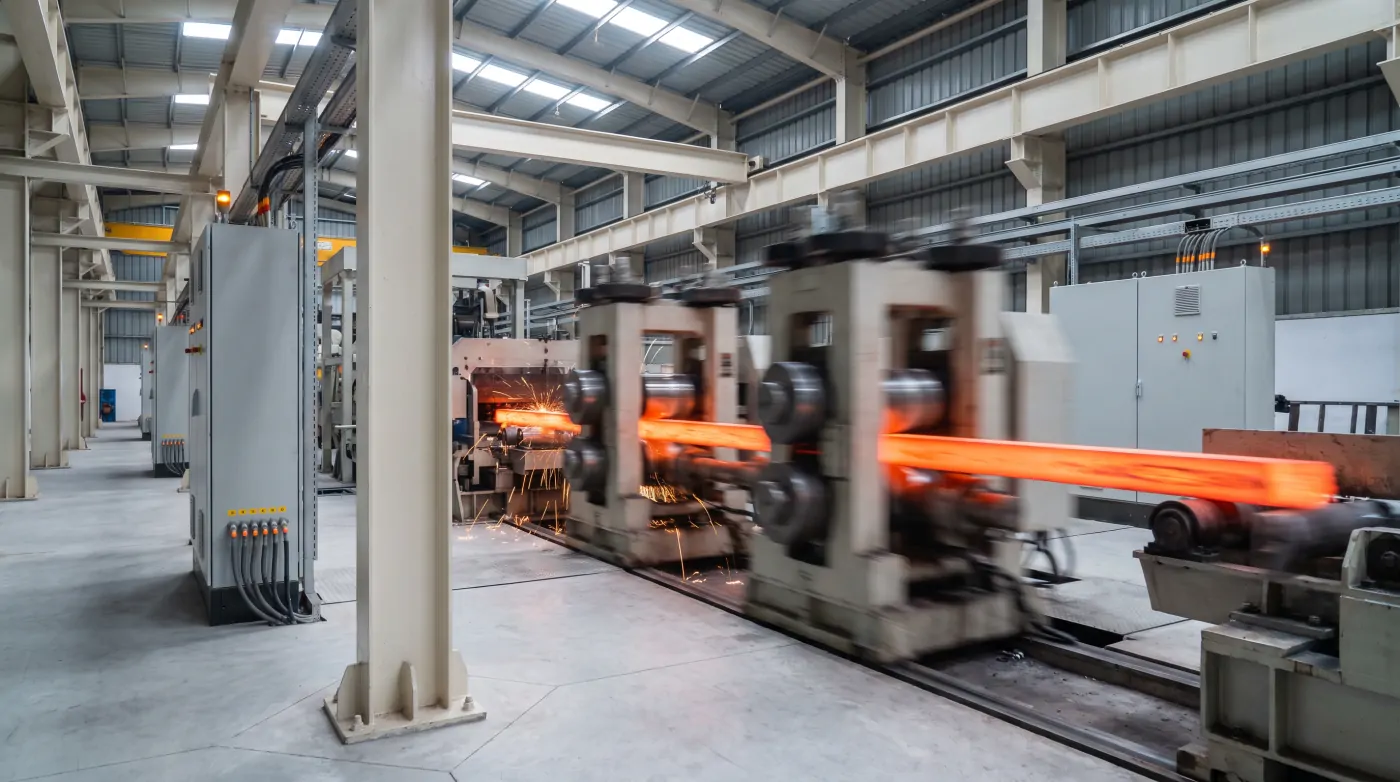
A TMT bar mill turns a hot billet into finished reinforcement bar in a few seconds, passing it through a sequence of rolling stands that each reduce its cross-section. The faster and more consistently the mill runs, the more tonnes it produces per shift — and nearly all of that consistency comes from the drives and automation, not the rolls.
This article walks through the electrical and automation systems in a typical bar mill and where upgrades usually pay back fastest.
The Process in Brief
- Reheating furnace heats billets to rolling temperature (typically around 1100–1200 °C).
- Roughing mill stands make the first large reductions.
- Intermediate mill stands continue reducing the section.
- Finishing mill stands bring the bar to its final size.
- Quenching (thermo-mechanical treatment) — a water box rapidly cools the bar surface to form the hardened outer layer that gives TMT bars their strength.
- Dividing shear cuts the bar into cooling-bed lengths.
- Cooling bed, then cold shear to commercial lengths, then bundling.
Stand Drives and Cascade Speed Control
Because the bar gets longer at every stand, each stand must run faster than the one before it. The ratio between neighbouring stand speeds must match the reduction in that pass exactly. If a downstream stand runs too slowly, the bar pushes up between stands (a "loop" grows and can cobble); too fast, and the bar is stretched under tension, changing its size.
Automation handles this with cascade (successive) speed control: when the operator trims the speed of one stand, the change is passed automatically to all upstream (or downstream) stands so the speed ratios stay correct. On modern mills this runs in the mill PLC and is sent to each stand drive — DC or AC — over a fieldbus.
Loop Control
Between the intermediate and finishing stands, the bar is often allowed to form a controlled loop on a looper. A loop scanner measures loop height, and the PLC adjusts the upstream stand's speed to hold the loop at its setpoint. Good loop control gives tension-free rolling, which means better size tolerance and fewer cobbles. Poorly tuned loop control is one of the most common causes of size variation in finished bar.
Flying Shears
Shears cut the bar while it is moving — for crop and cobble cutting at the head and tail, and for dividing into cooling-bed lengths. The shear drive must accelerate to bar speed, cut and stop within a fraction of a second, so it is usually a high-dynamic AC servo drive or a DC drive with a precise position control loop. Hot metal detectors and pulse encoders tell the PLC exactly where the bar is. Optimising dividing cuts — so that the final commercial lengths leave minimum short pieces — directly increases yield.
Quenching and Cooling Bed
The quenching box needs controlled water flow and pressure for each bar size. Automating valve control and recording water parameters per batch helps keep mechanical properties consistent from heat to heat. The cooling bed itself is driven by motors that index the bars across; synchronising it with the dividing shear prevents bars being dropped onto each other.
The Electrical Backbone
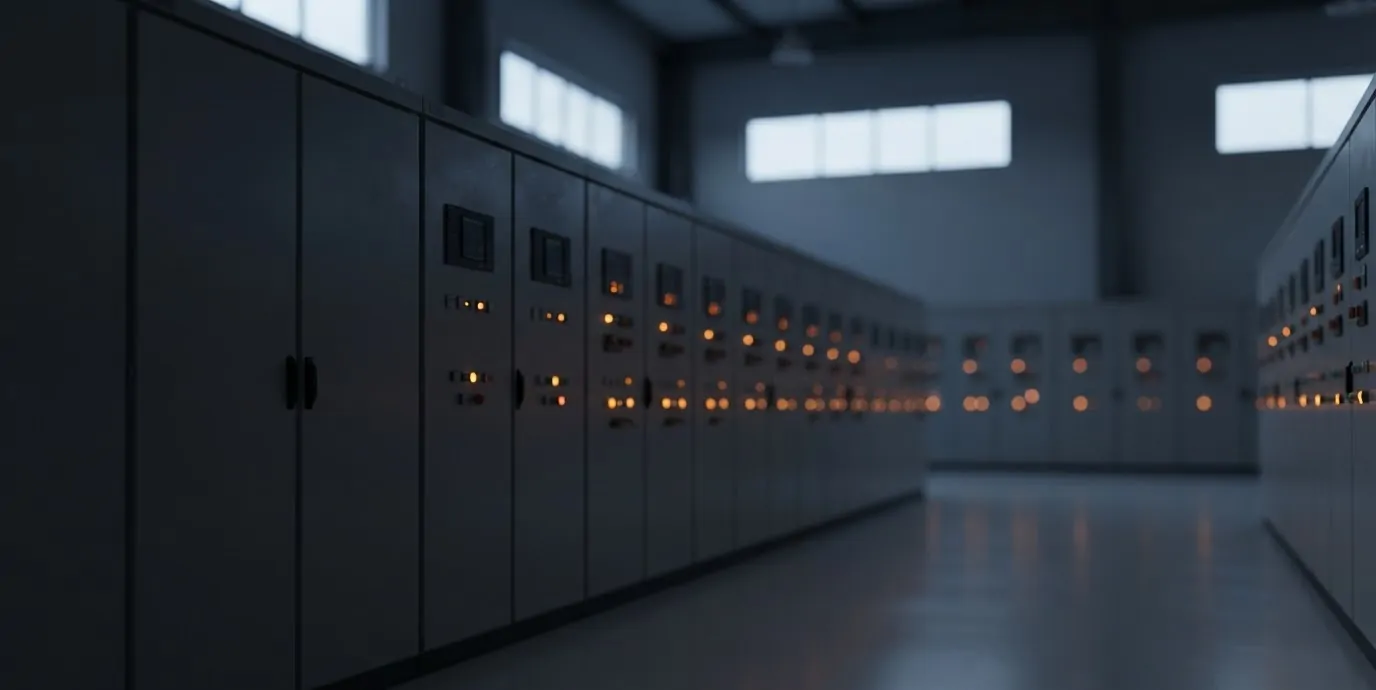
- MCC and drive panels for stands, pinch rolls, shears and the cooling bed.
- PLC system for sequencing, cascade control, loop control and interlocks.
- HMI/SCADA at the pulpit, showing stand speeds, currents, loop heights and alarms.
- Instrumentation — hot metal detectors, loop scanners, encoders and pyrometers.
- Power quality — large thyristor DC drives generate harmonics and draw reactive power, so harmonic filters and power factor correction are often needed.
Upgrades With the Fastest Payback
- Digitalising old analogue stand drives — modern digital DC drives or AC drives give better speed accuracy, fault logs and communication to the PLC.
- PLC-based cascade and loop control — replacing manual speed trimming reduces cobbles and size variation.
- Shear optimisation — accurate bar tracking and cut-to-length logic increase yield.
- SCADA and data logging — trends of stand current and speed make it obvious where and when problems start.
- Energy measures — VFDs on furnace combustion fans and cooling-water pumps, and oxygen trim control on the reheating furnace.
Practical Advice for Mill Owners
Plan upgrades stand by stand during scheduled shutdowns rather than all at once. Keep a complete backup of every drive and PLC program, label every cable, and train operators on the new screens before the restart. Most importantly, commission with the mill running real bars — tuning that looks perfect with no load often needs adjustment once steel is in the stands.
Kamakshi supports rolling mills with AC & DC drive repair, PLC programming, SCADA, furnace oxygen analysis and MCC and drive panels. See how we work with rolling mills and steel plants.
Further Reading
- Thyristor DC Drive Repair for Rolling Mills
- Oxygen Analysers for Reheating Furnaces
- SCADA System Guide
Related Articles
Explore more technical guides from our automation knowledge base.