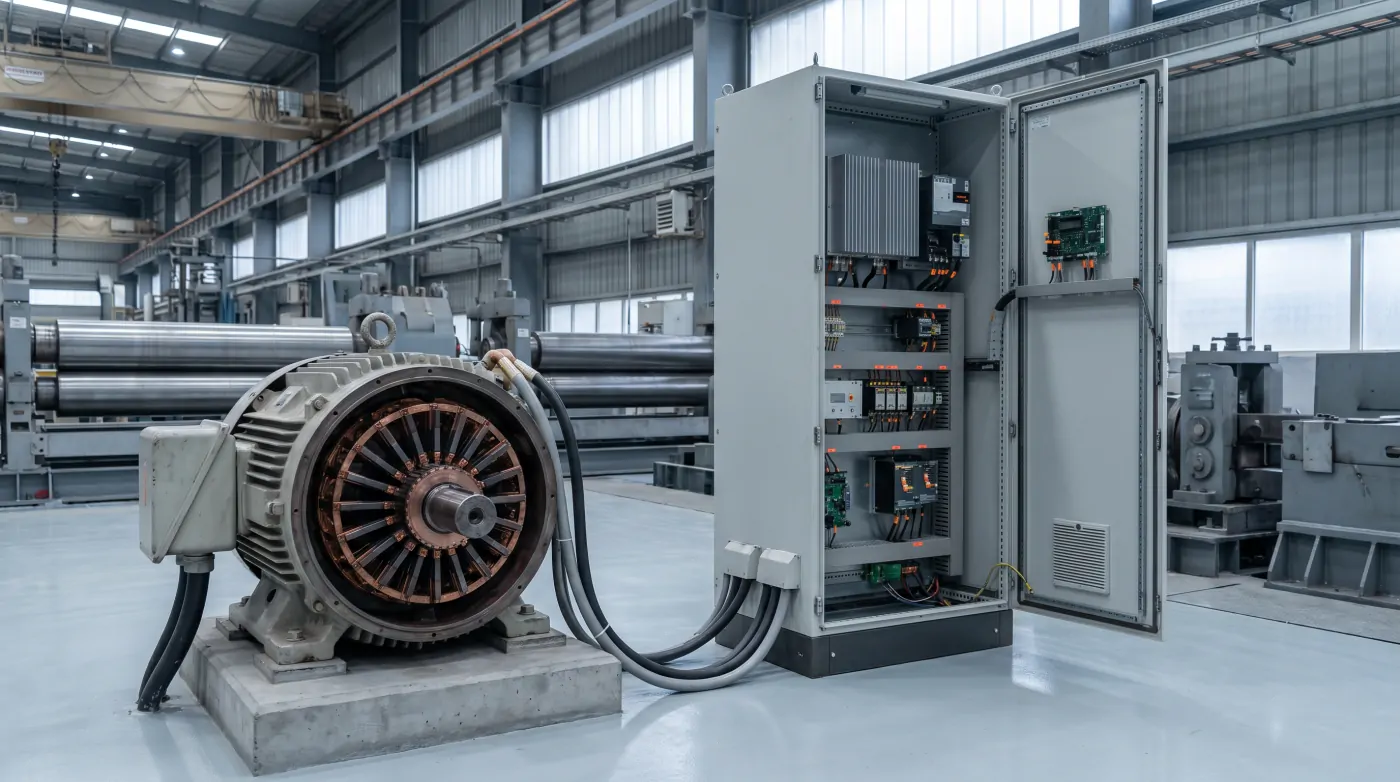
Many rolling mills in Gujarat, Maharashtra and across India still run their roughing and intermediate stands on DC motors fed by thyristor (SCR) drives. DC drives give excellent low-speed torque, simple speed control and a long service life — but when one trips, the whole mill line stops and every minute costs billets, power and labour.
This article explains how a thyristor DC drive is built, the faults that cause most mill stoppages, and how to approach fault-finding in a safe, systematic way.
How a Thyristor DC Drive Works
A DC drive has two power sections:
- Armature converter — a three-phase, six-pulse thyristor bridge that converts AC supply to a controlled DC voltage for the motor armature. The firing angle of the thyristors sets the armature voltage and therefore the motor speed. Drives that need to brake or reverse use two anti-parallel bridges (four-quadrant drives).
- Field supply — a smaller controlled or uncontrolled rectifier that supplies the shunt field winding. Field current sets the motor's flux; weakening the field allows speeds above base speed.
Around these sit the control board, a speed feedback device (DC tachogenerator or encoder), current transformers or shunts for armature current measurement, and protection circuits.
The Faults That Stop Rolling Mills
Field Failure / Field Loss
Loss of field is one of the most dangerous DC motor conditions: with no flux, the motor can overspeed or draw very high armature current. The drive trips on field failure to prevent this.
Typical causes: a blown field fuse, a loose field terminal, a failed field rectifier diode or thyristor, an open field winding, or a field current setting that has drifted. Measure field current with a clamp meter against the motor nameplate value, and check field winding resistance with the drive isolated.
Armature Overcurrent
An armature overcurrent trip can come from the mill itself — a cobble, a bar jamming in a stand, cold steel entering the stand — or from inside the drive. Check whether the trip coincides with the bar entering the stand. If it does, look at the process: furnace temperature, roll gaps and stand speed matching. If it trips with no bar in the stand, suspect the drive, the current feedback circuit or the motor.
Tachogenerator or Encoder Failure
A DC tacho gives the drive its speed feedback. If the tacho output drops (worn brushes, a broken coupling, a loose wire), the drive thinks the motor is running slowly and increases armature voltage — which can cause overspeed. Most drives have tacho-loss detection, but it must be set correctly. Inspect tacho brushes and couplings at every planned shutdown.
Thyristor and Fuse Failures
Blown semiconductor fuses usually mean a thyristor has failed short, or that the drive experienced a severe fault current (a commutation failure during regeneration is a common cause on four-quadrant drives). Each thyristor can be checked with the drive isolated: a healthy SCR blocks in both directions until it receives a gate pulse. Gate pulse transformers and firing cards also fail, and a missing pulse on one thyristor shows up as uneven armature current ripple on an oscilloscope.
Motor Commutation Problems
Not every DC drive fault is in the drive. Sparking at the commutator, worn or wrong-grade brushes, a dirty commutator or weak brush springs cause unstable current and nuisance trips. Carbon dust inside the motor also lowers insulation resistance.
A Safe Fault-Finding Order
- Read and record the fault code, armature current and speed at the moment of the trip.
- Isolate and lock out both the armature and field supplies. DC drives often have separate supplies for control, field and armature.
- Inspect visually for burnt components, discoloured busbars, loose lugs and blown fuses.
- Test the motor — armature and field insulation resistance, winding resistance, brushes and commutator.
- Check feedback devices — tacho output voltage per 1000 rpm against its rating, encoder signals.
- Test power semiconductors and fuses with the drive de-energised.
- Power up the control alone and check supply voltages and firing pulses before applying armature power.
- Run on low current limit with the motor uncoupled, if the mill allows it, before returning to production.
Repair, Retrofit or Replace?
Older analogue DC drives can usually be repaired at board level, but spare cards become harder to find each year. Two common upgrade paths are:
- Digital DC drive retrofit — replace the old drive with a modern digital DC drive (keeping the existing DC motor). You gain fault logging, communication to the mill PLC and easier tuning.
- AC conversion — replace both the DC motor and drive with an AC motor and VFD. This removes brush and commutator maintenance but costs more and needs foundation and coupling changes.
For many mills, a digital DC retrofit gives the best payback: the motor investment is kept, and downtime is limited to a planned shutdown.
Preventive Maintenance for Mill DC Drives
- Clean and re-torque power connections at every major shutdown — thermal cycling loosens them.
- Keep drive panels sealed and cooled; mill scale and dust shorten electronic life.
- Inspect brushes, commutators and tacho couplings on a fixed schedule.
- Keep a backup of all drive parameters and a set of critical spare fuses and thyristors on site.
Kamakshi repairs and retrofits AC and DC drives for rolling mills and steel plants, and builds the MCC and drive panels that feed them. If a stand is down, send us the drive make, model and fault code on WhatsApp.
Further Reading
- Rolling Mill Automation for TMT Bar Plants
- VFD Fault Codes Explained
- Predictive Maintenance in Industrial Automation
Related Articles
Explore more technical guides from our automation knowledge base.