

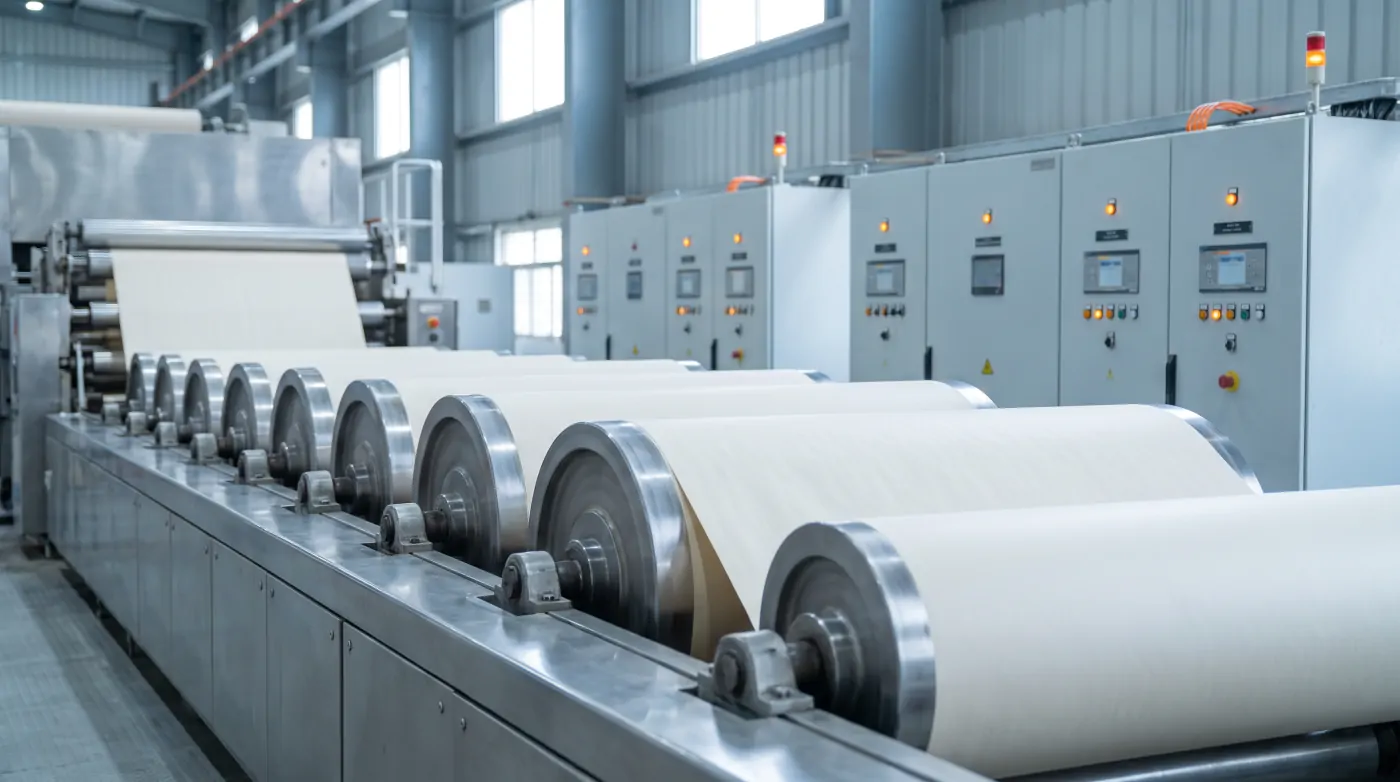
A paper machine is one long, continuous web of fibre moving through sections that each do a different job — forming, pressing, drying, calendering and reeling. Each section is driven separately, yet all of them must move the same sheet without stretching it to breaking point or letting it go slack. The system that makes this possible is the sectional drive.
The Main Sections
- Wire (forming) section — the stock is spread on a moving wire mesh and water drains out to form the sheet.
- Press section — rolls squeeze out more water.
- Dryer section — steam-heated cylinders, arranged in groups, dry the sheet.
- Size press / coater (on some machines) — applies starch or coatings.
- Calender — rolls smooth the sheet and control its thickness.
- Pope reel — winds the finished sheet onto a reel spool.
Each section, and often each dryer group, has its own motor and drive.
Understanding Draw
As the sheet moves through the machine, it changes — it shrinks as it dries and stretches under tension. To keep the sheet properly supported, each section must run at a slightly different speed from the one before it. This speed difference is called draw, usually expressed as a percentage or in metres per minute.
The sectional drive system sets a line speed reference (the master speed), and each section's drive follows that reference plus its own draw setting. When the operator increases machine speed, every section speeds up together while keeping its draw. When the operator adjusts the draw of one section, only the relationship between that section and its neighbours changes.
Too little draw and the sheet goes slack, wanders or wraps around rolls. Too much draw and the sheet breaks. Draw that drifts as conditions change is one of the main causes of web breaks.
Load Sharing
Some sections have several motors driving the same felt or fabric — for example, multiple drives in a press section or within a dryer group. If they run purely on speed control, one motor can end up doing most of the work while another is driven along by the felt. Load sharing (a master/follower or droop arrangement) balances torque between these motors so felts and gearboxes last longer.
Tension Control at the Reel and Winder
At the pope reel and the rewinder, the drive must keep sheet tension constant as the reel diameter grows. This uses tension control based on calculated or measured roll diameter, and sometimes load cells on a guide roll for direct tension measurement. Good tension control gives evenly wound reels without loose cores or crushed edges.
From DC Drives to AC Sectional Drives
Many older Indian machines still run DC sectional drives with analogue speed controllers. Common problems include draw drifting with temperature, tacho wear, and difficulty finding spare cards.
A modern retrofit typically uses:
- AC motors with vector-controlled VFDs, or digital DC drives where existing DC motors are kept.
- A common DC bus in multi-drive line-ups, so energy regenerated by one section can be used by another.
- A PLC-based master speed and draw control with an HMI where operators set line speed and draws, and recipes for each paper grade.
- Encoder feedback for accurate speed holding.
The result is usually more stable draw, faster grade changes, fewer breaks and a clear fault history when something does go wrong.
Commissioning Tips
- Tune each drive's speed loop individually with its section uncoupled where possible.
- Set the draw ramp rates so that speed-ups do not snatch the sheet.
- Verify load sharing on multi-motor sections under real felt tension, not just at no load.
- Save draw settings as recipes for each paper grade, and record them at the end of commissioning.
Energy Opportunities
Beyond the sectional drive, paper mills have many fans and pumps — vacuum pumps, approach-flow pumps, hood fans — that are ideal for VFD-based energy saving. A focused energy audit usually finds these quickly.
Kamakshi works with paper mills on VFD setup and commissioning, AC & DC drive repair, PLC programming and energy saving programs. See our work with paper mills.
Further Reading
- VFD Energy Saving in Industrial Plants
- Energy Audit for Manufacturing Plants
- HMI Screen Design Best Practices
Related Articles
Explore more technical guides from our automation knowledge base.