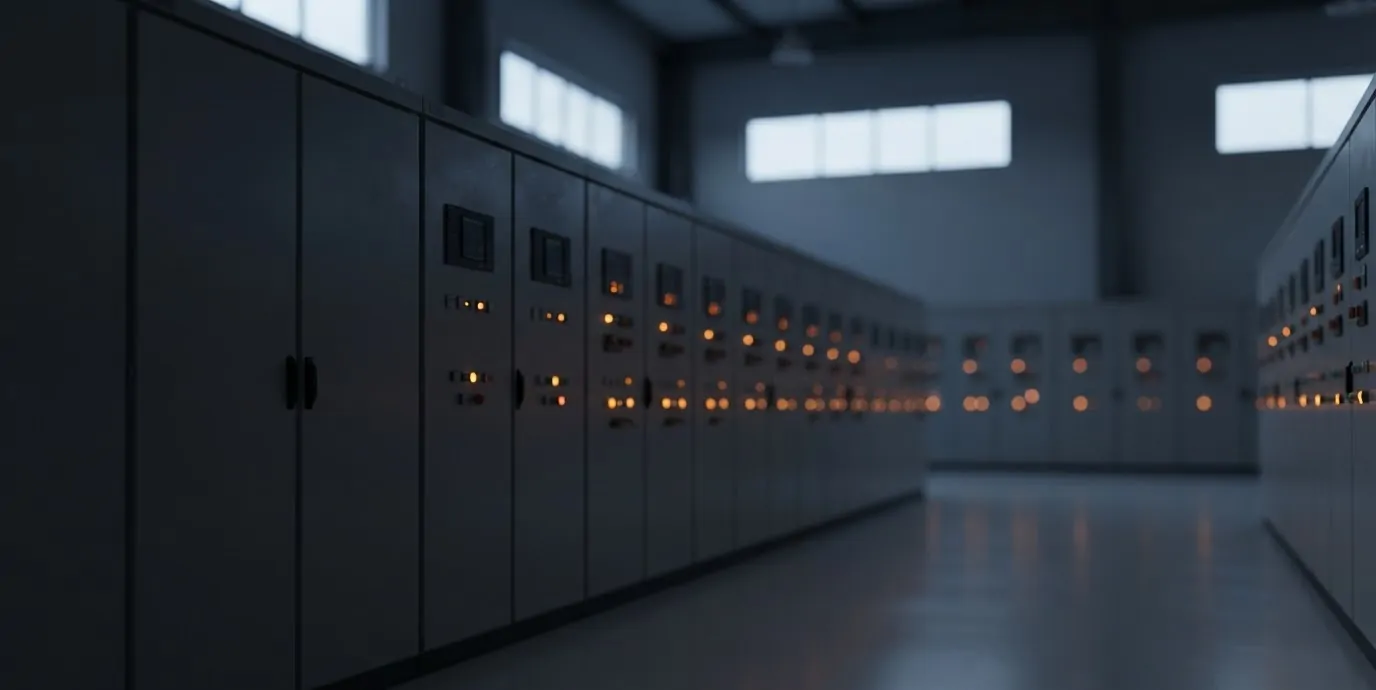

"IP54" or "IP65" appears on almost every panel specification, but it is often chosen by habit rather than by need. Specify too low, and dust and water shorten the life of everything inside. Specify too high, and you pay for sealing you don't need — and may create heat problems for drives and electronics. Here is how to choose correctly.
What an IP Code Means
The IP (Ingress Protection) code is defined in IEC 60529 (adopted in India as IS/IEC 60529). It has two digits:
First digit — protection against solid objects and dust
| Digit | Protection |
|---|---|
| 0 | No protection |
| 1 | Objects larger than 50 mm (e.g. a hand) |
| 2 | Objects larger than 12.5 mm (e.g. a finger) |
| 3 | Objects larger than 2.5 mm (tools, thick wires) |
| 4 | Objects larger than 1 mm (thin wires, small tools) |
| 5 | Dust-protected — some dust may enter but not enough to interfere with operation |
| 6 | Dust-tight — no dust enters |
Second digit — protection against water
| Digit | Protection |
|---|---|
| 0 | No protection |
| 1 | Vertically dripping water |
| 2 | Dripping water with enclosure tilted up to 15° |
| 3 | Spraying water up to 60° from vertical |
| 4 | Splashing water from any direction |
| 5 | Water jets from any direction |
| 6 | Powerful water jets |
| 7 | Temporary immersion |
| 8 | Continuous immersion (conditions specified by the manufacturer) |
So IP54 means dust-protected and splash-proof; IP55 adds protection against water jets; IP65 is dust-tight and jet-proof.
Choosing the Right Rating
- Clean indoor electrical room — IP42 to IP54 is usually sufficient, and allows easier ventilation.
- Production floor with normal dust — IP54 is the common choice.
- Heavy dust (textile, cement, flour, wood, rolling mill scale) — IP55 or higher, with filtered ventilation or panel air conditioning.
- Outdoor under a canopy — IP55, plus a canopy against direct sun and rain.
- Fully outdoor or washdown areas (food, pharma, chemical) — IP65 or IP66, often in stainless steel.
Remember that hazardous areas with flammable gas or dust need certified explosion-protected equipment — an IP rating alone is not enough.
Heat: The Hidden Trade-Off
A sealed panel keeps dust out but also keeps heat in. VFDs, power supplies and transformers dissipate a lot of heat, and electronics age quickly above their rated ambient temperature (often 40–50 °C). Options include:
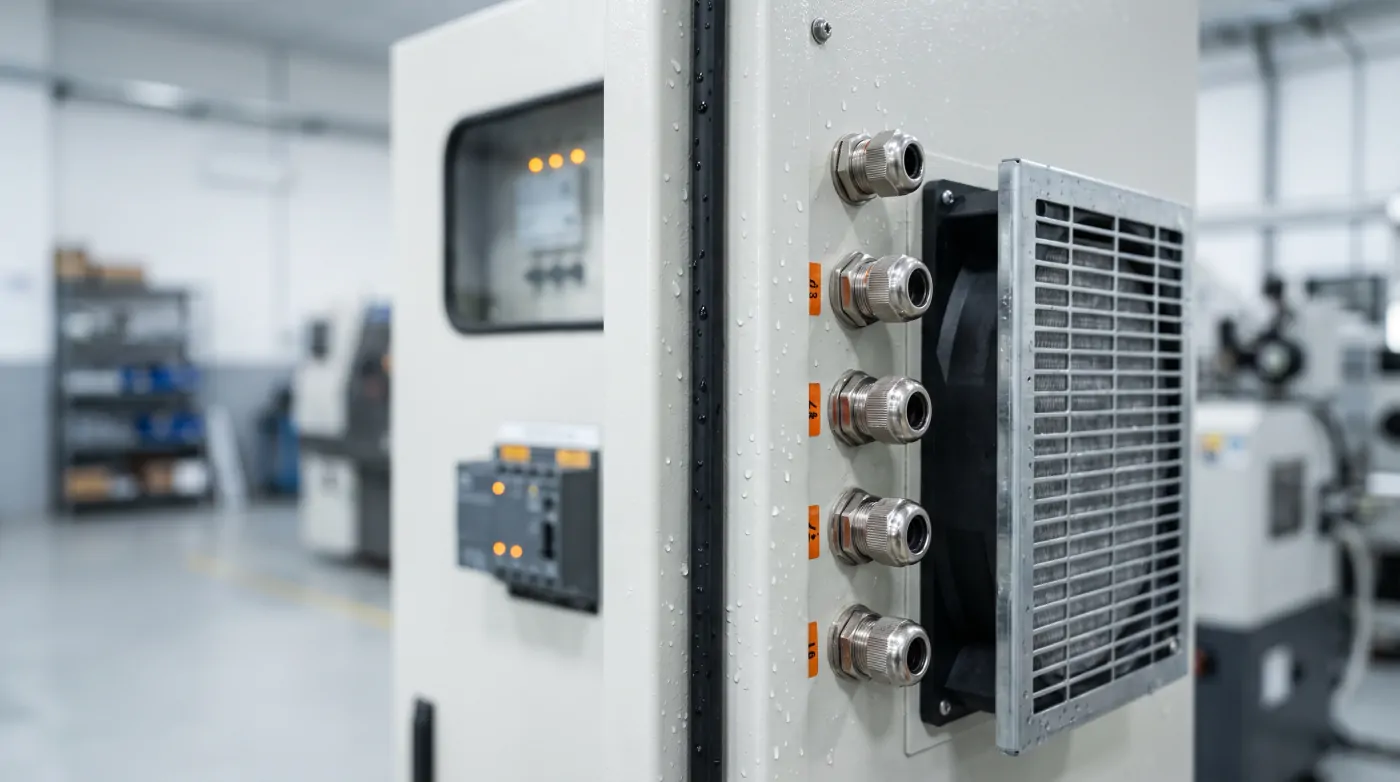
- Filter fans with matching exhaust grilles — fans and filters are available with IP54/IP55 ratings, but the filters must be cleaned regularly or the panel overheats.
- Panel air conditioners — keep IP55/IP65 panels sealed while removing heat; essential in hot Gujarat summers for drive-heavy panels.
- Air-to-air heat exchangers — for moderate heat loads where the outside air is cooler than the panel's internal limit.
- Mounting drives with heatsinks through the panel back so most heat is rejected outside the sealed area.
Do a heat calculation for every panel with drives — it is far cheaper than replacing failed drives.
What Spoils an IP Rating in Practice
- Cable entries without proper glands or with unused holes left open.
- Damaged or missing door gaskets.
- Doors left open for "cooling".
- Push buttons, meters and HMIs with a lower IP rating than the enclosure.
- Ventilation cut-outs added on site without matching filters.
The panel is only as good as its weakest opening, so specify the IP rating for the complete assembly, including door-mounted devices and cable entries.
How to Write It in Your Specification
State the required IP rating for the complete assembly as installed, the installation environment (indoor/outdoor, dust, washdown), the maximum ambient temperature, and the cooling method. Ask the manufacturer to show how the heat load is handled at that IP rating.
Kamakshi designs and builds control and electrical panels to the right IP rating for each environment, with proper heat management for VFD and PLC panels.
Further Reading
- How to Choose a Control Panel Manufacturer in Ahmedabad
- Control Panel Manufacturing Checklist
- Industrial Panel Earthing and Safety
Related Articles
Explore more technical guides from our automation knowledge base.