

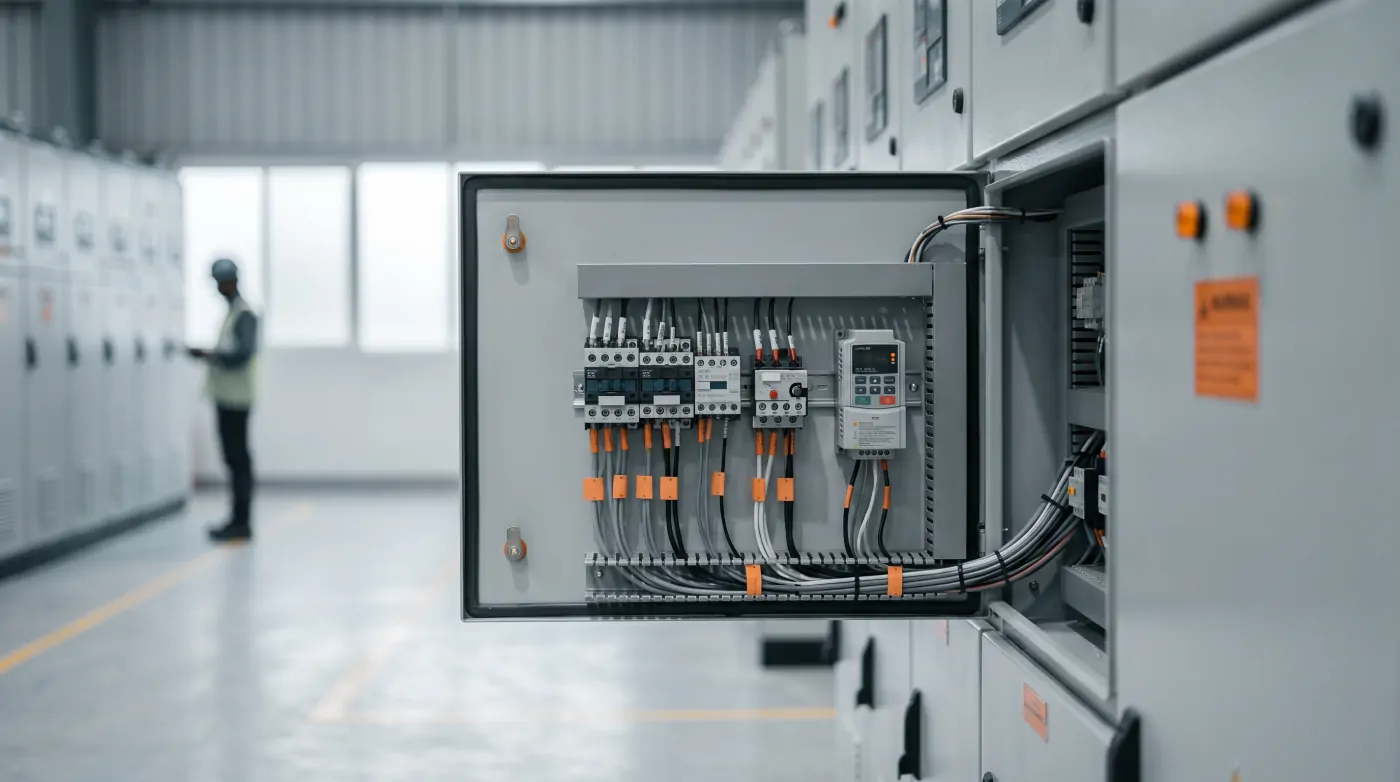
Every induction motor needs a way to start. The method you choose affects the starting current drawn from your supply, the mechanical stress on couplings and gearboxes, the panel cost, and whether you can save energy once the motor is running. Here is how the four common methods compare.
Direct-On-Line (DOL)
The motor is connected straight to the full supply voltage through a contactor and overload relay.
- Starting current: about 6–8 times full-load current (FLC).
- Starting torque: full — the motor's natural locked-rotor torque.
- Pros: simplest, cheapest, most reliable; no extra components.
- Cons: high inrush can cause voltage dips that affect other equipment; mechanical shock on belts, couplings and gearboxes.
- Typical use: small motors (commonly up to about 7.5 kW, though the limit depends on the supply strength and local rules), and loads that need full starting torque.
Star-Delta
The motor starts with its windings connected in star (each winding sees 1/√3 of line voltage), then a timer switches it to delta for running. The motor must have six terminals and be rated for delta at the supply voltage.
- Starting current: about one-third of DOL starting current.
- Starting torque: also about one-third of DOL torque.
- Pros: low cost, widely understood, reduces inrush.
- Cons: low starting torque makes it unsuitable for heavily loaded starts; the changeover from star to delta causes a current and torque spike; three contactors and a timer to maintain.
- Typical use: pumps, fans and compressors that start lightly loaded.
A common fault is a wrongly set changeover timer. If the motor has not reached near full speed in star before switching to delta, the transition spike can be almost as large as a DOL start.
Soft Starter
Thyristors in the supply lines ramp the motor voltage up smoothly during starting (and optionally down during stopping), then a bypass contactor usually takes over once the motor is at full speed.
- Starting current: adjustable, typically 2–4 times FLC.
- Starting torque: reduced and adjustable.
- Pros: smooth start with no transition spike; soft stop prevents water hammer in pumps; compact; built-in motor protection.
- Cons: cannot change running speed, so no energy saving while running; generates heat during starting.
- Typical use: pumps, fans, conveyors and compressors that run at fixed speed.
Variable Frequency Drive (VFD)
A VFD converts the supply to a variable voltage and frequency, controlling the motor's speed from zero to rated speed (and above).
- Starting current: typically around rated current — usually no higher than about 1.5 times FLC.
- Starting torque: can deliver full or even more than rated torque from standstill in vector control mode.
- Pros: lowest starting current; speed control; large energy savings on variable-flow pumps and fans; soft start and stop; extensive protection and diagnostics.
- Cons: highest cost; generates harmonics; needs proper cabling and EMC practice; more heat in the panel.
- Typical use: any load where speed must vary — pumps and fans with changing demand, conveyors, extruders, machine tools, winders and process lines.
Comparison Table
| Method | Starting current | Starting torque | Speed control | Relative cost |
|---|---|---|---|---|
| DOL | 6–8 × FLC | 100% | No | Lowest |
| Star-delta | ~2–2.7 × FLC | ~33% | No | Low |
| Soft starter | 2–4 × FLC (adjustable) | Reduced, adjustable | No | Medium |
| VFD | ≤ ~1.5 × FLC | Up to 100%+ | Yes | Highest |
A Simple Selection Guide
- Does the load need variable speed? If flow, pressure or line speed changes during operation, choose a VFD — the energy saving usually pays for it.
- Fixed speed, small motor, strong supply? DOL is fine.
- Fixed speed, larger motor, light starting load, budget-sensitive? Star-delta.
- Fixed speed, need a smooth start or stop (pumps, conveyors)? Soft starter.
- Running from a DG set? Prefer soft starters or VFDs — large DOL or star-delta starts can stall a generator.
Panel Design Notes
Size contactors and overloads to the motor's actual current, not just its kW. Use type-2 coordination between the short-circuit protective device and the starter so the starter survives a short circuit without damage. For VFDs, plan ventilation and the cable lengths between the drive and the motor.
Kamakshi designs MCC and starter panels and handles VFD setup and commissioning. If you are not sure which starter suits a motor, send us the motor nameplate and load details.
Further Reading
Related Articles
Explore more technical guides from our automation knowledge base.