
Understanding the Core Difference
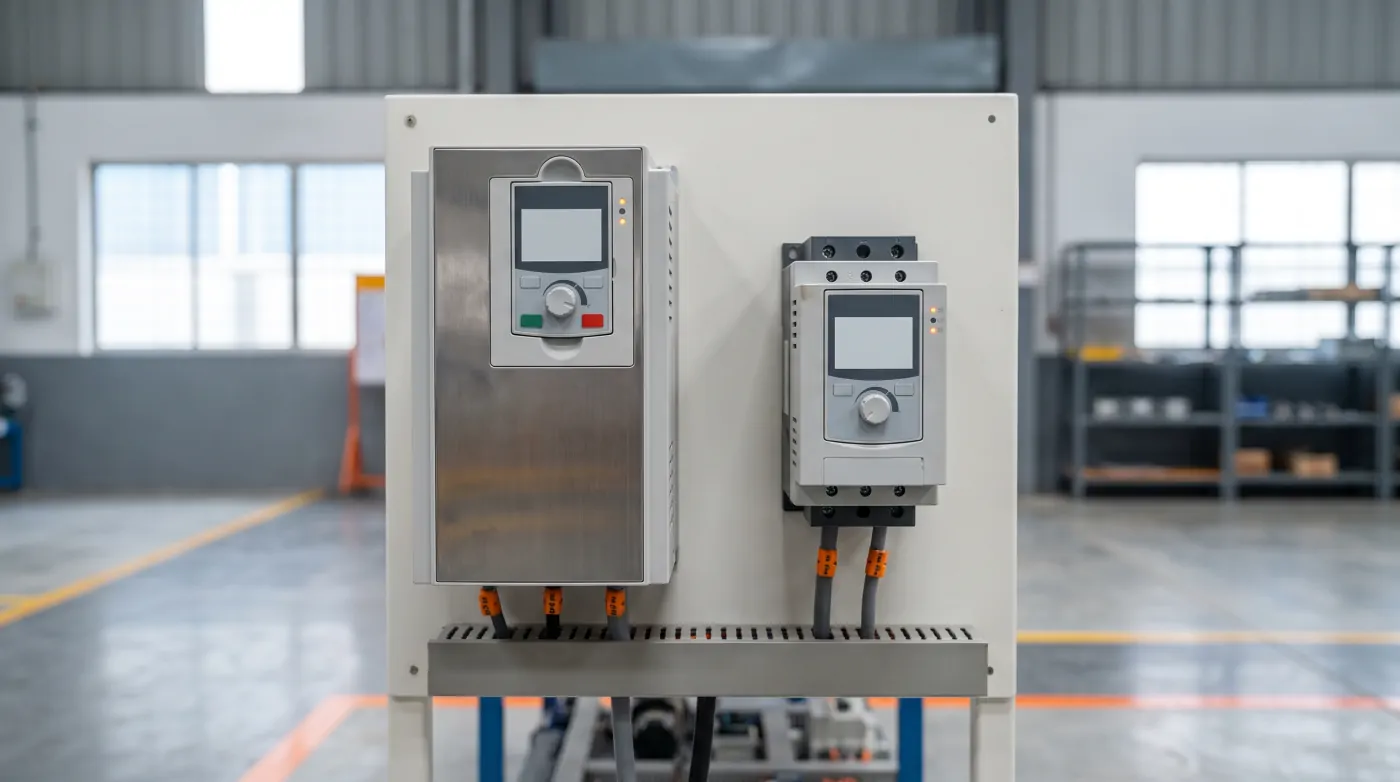
Variable Frequency Drives (VFDs) and soft starters are both used to control AC induction motors, but they serve different purposes and suit different applications. A soft starter controls the voltage applied to the motor only during the start and stop phases. Once the motor reaches full speed, the soft starter bypasses itself and the motor runs at full line voltage. A VFD, on the other hand, continuously controls both voltage and frequency throughout the entire operating cycle, giving you full speed control from zero to maximum RPM at any time.
This fundamental difference in operating principle determines which device is appropriate for your specific application, load type, budget, and energy goals.
How a Soft Starter Works
A soft starter uses thyristors (SCRs) to gradually ramp up voltage to the motor during start. This reduces inrush current, which can typically reach 6–8 times the full load current in a direct-on-line (DOL) start. By limiting this inrush, soft starters protect the motor windings, reduce mechanical stress on couplings and gearboxes, and prevent voltage dips that can trip other equipment on the same distribution board.
During stopping, a soft starter can provide a controlled voltage ramp-down, which is useful for conveyor systems where sudden stops cause product spillage or for pump systems where water hammer is a concern. Once the motor is running at full speed, the built-in bypass contactor closes and the thyristors are taken out of circuit, which means no energy is lost in the device during normal running.
Soft starters are simpler, cheaper, and more compact than VFDs. They are ideal when you only need controlled starting and stopping, not variable speed.
How a VFD Works
A VFD (also called an inverter or variable speed drive) rectifies incoming AC power to DC, then inverts it back to AC at a controlled frequency and voltage. By adjusting the output frequency, the VFD controls the motor shaft speed precisely. Running a pump or fan at 80% speed instead of 100% while using a throttling valve or damper can reduce energy consumption by up to 50%, since power varies with the cube of speed for centrifugal loads.
VFDs also provide soft-start capability as a standard feature, so they replace soft starters entirely for variable-speed applications. Additional features typically include PID control loops, speed presets, dynamic braking, torque limiting, built-in EMC filters, and communication interfaces like Modbus RTU or PROFIBUS.
The trade-off is higher upfront cost, more complex installation (cable screening, output reactors, EMC considerations), and greater heat dissipation requiring adequate panel ventilation.
Energy Saving Comparison
For centrifugal loads such as pumps, fans, blowers, and compressors, a VFD delivers significant energy savings when the motor does not need to run at full speed continuously. A soft starter provides no energy savings during running since the motor always operates at full speed once started.
For constant-speed loads such as conveyor belts, crushers, and positive displacement pumps, a soft starter is often the more cost-effective choice. The energy saving argument for a VFD disappears when the process requires full speed 100% of the time.
As a practical guide for Indian plants: if your motor drives a pump or fan and your process allows speed variation, a VFD will typically pay back its higher cost within 12–24 months through electricity savings at ₹7–9 per kWh industrial tariff rates.
Cost Comparison for Indian Market
For a 15 kW motor in India, a quality soft starter (ABB, Schneider, Siemens) costs approximately ₹18,000–₹35,000. A comparable VFD for the same motor costs ₹30,000–₹65,000 depending on the brand and features. For larger motors above 75 kW, the cost gap widens further.
Beyond initial purchase, installation costs differ too. A soft starter requires minimal additional wiring and no output filters for standard cabling distances. A VFD installation for motors more than 20–30 meters away from the panel requires screened cable and often an output dU/dt filter or sine filter to protect motor windings from reflected voltage spikes, adding ₹8,000–₹25,000 to the project cost.
Maintenance costs are broadly similar, but VFDs have more internal components including capacitors and IGBTs that degrade over time. Budget for capacitor replacement every 5–7 years in humid industrial environments.
Application Selection Guide
Choose a soft starter when:
- The motor runs at fixed speed and load once started
- You need to reduce starting current and mechanical shock only
- Budget is constrained and energy saving is not a priority
- Applications: conveyors, crushers, compressors, heavy pumps with fixed speed
Choose a VFD when:
- The process benefits from variable speed (pumps, fans, HVAC)
- Energy saving is a key project objective
- You need precise torque or speed control during running
- You want to eliminate separate soft starter and bypass contactor
Common Mistakes to Avoid
Installing a soft starter on a centrifugal pump that runs partially throttled all day is a missed energy opportunity. Conversely, installing a VFD on a conveyor that always runs at 50 Hz wastes capital and adds unnecessary complexity.
Another common mistake in Indian installations is using a VFD without proper earthing and cable screening. VFDs generate high-frequency switching noise that can interfere with PLCs, instruments, and communication networks if the installation does not follow proper EMC practices.
Always specify the VFD for the motor's full rated current, not just its kW rating. A 15 kW motor may draw 30 A at 415 V, but if the actual application involves high starting torque, size the VFD for 150% overload capacity.
Summary
Both VFDs and soft starters have clear roles in industrial motor control. The decision comes down to whether your application needs variable speed and energy saving (VFD) or only controlled starting and stopping (soft starter). For Indian plants with rising energy costs, VFDs are increasingly cost-justified on pump and fan applications. For fixed-speed loads, a quality soft starter remains the practical, cost-effective solution.
Further Reading
Related Articles
Explore more technical guides from our automation knowledge base.