

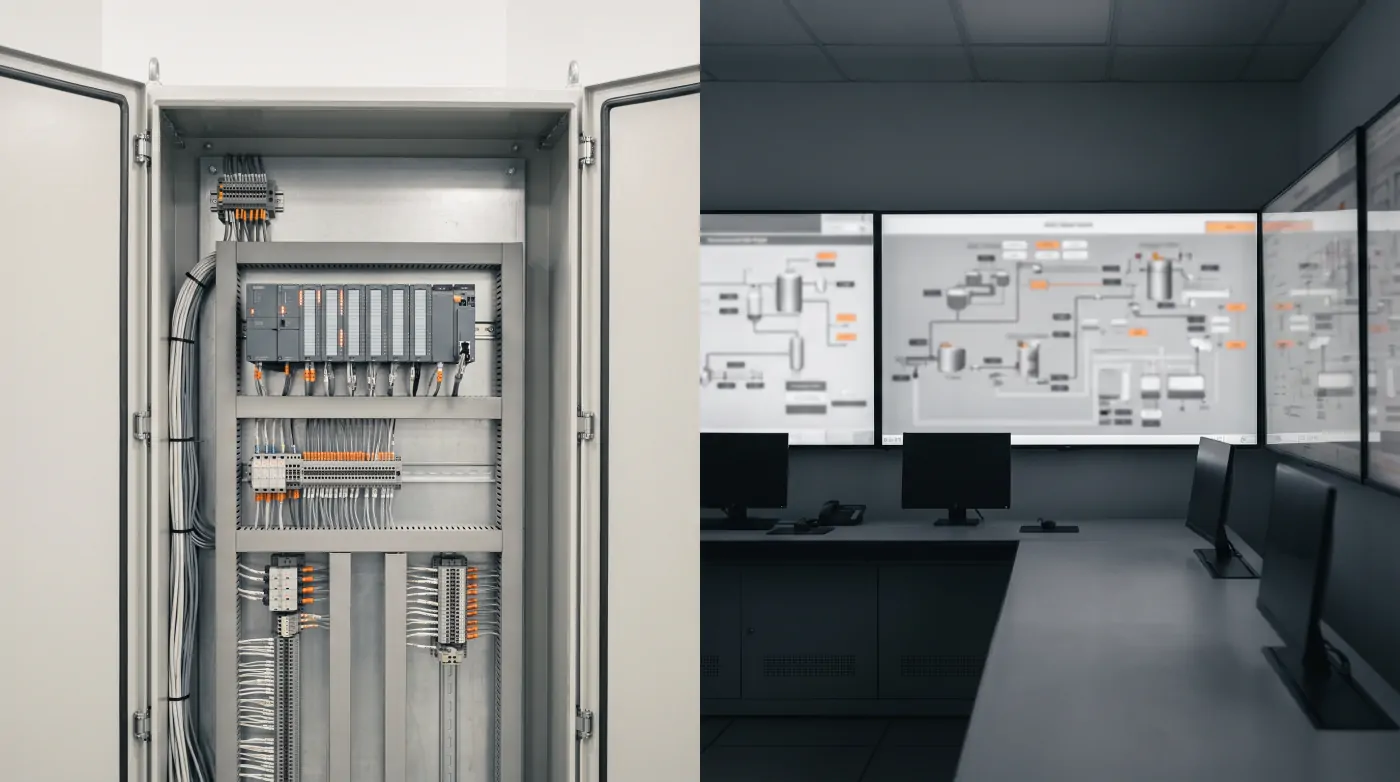
Why This Question Matters
One of the most common questions in industrial automation is whether a plant needs a PLC, a SCADA system, or both. The answer is usually both, but each one solves a different engineering problem.
A PLC controls the machine in real time. A SCADA system supervises the process, collects data, manages alarms, and gives operators visibility. When teams confuse the two, they often overspend on software, underspecify the controller, or build a system that looks good on screen but performs poorly on the plant floor.
What a PLC Does
A Programmable Logic Controller is the control engine of the machine or process. It reads digital and analog inputs, executes logic, and writes outputs every scan cycle.
Typical PLC responsibilities include:
- Starting and stopping motors
- Running machine sequences
- Handling interlocks and permissives
- Scaling analog signals
- Managing safety-related handshakes with separate safety hardware
- Exchanging data with HMIs, drives, and higher-level systems
If a conveyor must stop immediately on a sensor fault or a pump must switch to standby on pressure loss, that logic belongs in the PLC.
For a deeper look at controller structure, read PLC Programming Basics for Industrial Automation.
What a SCADA System Does
SCADA sits above the controller layer. It does not replace the PLC. Instead, it collects live values from controllers and turns them into an operating interface for the plant.
Typical SCADA responsibilities include:
- Real-time dashboards
- Alarm display and acknowledgement
- Historical trends
- Production reports
- Recipe or setpoint management
- Utility and energy monitoring
- Multi-machine visibility from a central room
That is why teams implementing central monitoring often start with SCADA System Guide for Modern Industrial Monitoring.
PLC vs SCADA at a Glance
| Function | PLC | SCADA |
|---|---|---|
| Real-time control | Yes | No |
| Machine sequencing | Yes | No |
| Alarms and trends | Limited | Yes |
| Historical data | Minimal | Yes |
| Operator dashboards | Basic HMI only | Yes |
| Plant-wide visibility | Limited | Yes |
| Data reporting | Limited | Yes |
How They Work Together
In a well-designed system, the PLC executes the critical logic while SCADA reads organized tags from the controller.
The flow usually looks like this:
- Sensors and devices connect to the PLC.
- The PLC runs the real control logic.
- The PLC publishes machine status, process values, alarms, and counters.
- SCADA reads those tags for visualization, trending, reporting, and user actions.
This separation makes the system easier to maintain. Even if the SCADA screen is unavailable, the machine can often continue operating because the control logic remains inside the PLC.
When You Need Only a PLC
Some standalone machines do not need a full SCADA layer. A packaging machine, simple pump set, or dedicated process skid may only need:
- PLC control
- Local HMI screen
- Basic alarms
- Local operator commands
In these cases, a clean PLC and HMI architecture is usually enough.
When You Need PLC Plus SCADA
Plants usually benefit from PLC plus SCADA when they need:
- Multiple machines monitored in one place
- Utility tracking
- Historical production data
- Central alarm management
- Remote supervision
- Better maintenance diagnostics
This is especially valuable when VFD data, downtime counters, and energy readings must be analyzed together. That is where projects often connect naturally to VFD Energy Saving in Industrial Plants.
Common Mistakes
Putting too much control in SCADA
SCADA should not become the main control layer for time-critical machine logic. Network delays, workstation failures, or software issues can create operational risk.
Poor tag naming in the PLC
Even the best SCADA platform becomes hard to maintain if the PLC exposes inconsistent, cryptic tags.
No alarm philosophy
If every status point becomes an alarm, operators stop trusting the system. Alarm priorities and acknowledgement workflows should be intentional.
Final Takeaway
The easiest way to think about the difference is this:
- PLC controls
- SCADA informs and supervises
When both layers are designed properly, plants gain reliable machine operation, better visibility, and faster troubleshooting.
Related Articles
Explore more technical guides from our automation knowledge base.