
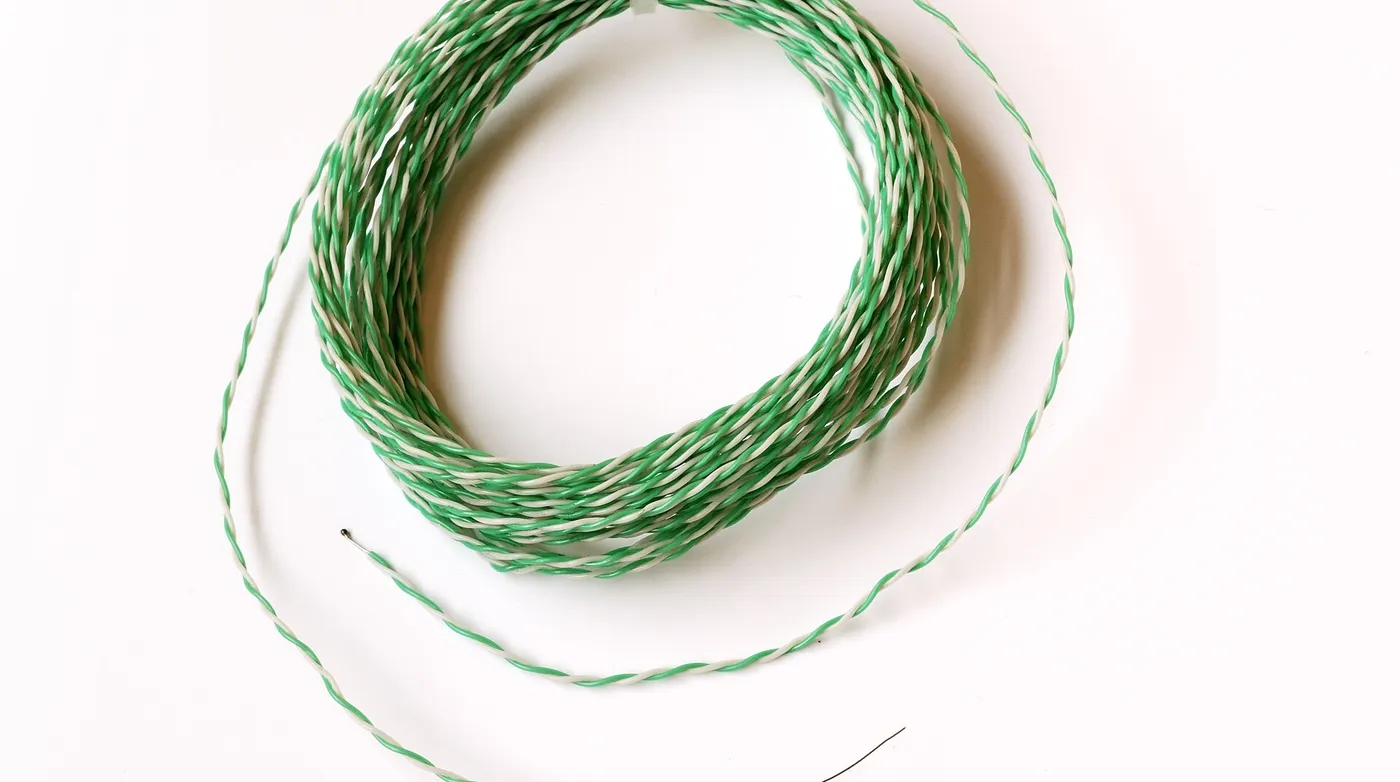
A thermocouple is two dissimilar metal wires joined at the measuring end. The junction produces a small voltage — a few tens of microvolts per degree — that depends on the temperature difference between the hot junction and the point where the wires connect to copper. Simple in principle, but picking the wrong type, sheath or cable is one of the most common reasons a furnace controller shows a temperature that the process clearly is not at.
This guide covers the types you will actually meet in Indian plants and how to choose between them.
The Common Types at a Glance
| Type | Conductors | Typical continuous range | Sensitivity | Where it fits |
|---|---|---|---|---|
| J | Iron / Constantan | 0 to about 750 °C | ~52 µV/°C | Plastic extruders, injection moulding, low-temperature ovens |
| K | Nickel-Chromium / Nickel-Aluminium | 0 to about 1200 °C | ~41 µV/°C | General purpose: furnaces, heat treatment, ducts, molten aluminium |
| N | Nicrosil / Nisil | 0 to about 1250 °C | ~39 µV/°C | High-temperature work where K drifts |
| R | Platinum-13% Rhodium / Platinum | up to about 1450–1600 °C | ~10–12 µV/°C | Glass, steel soaking zones, ceramic kilns |
| S | Platinum-10% Rhodium / Platinum | up to about 1450–1600 °C | ~10–12 µV/°C | Same as R; older lab and calibration practice |
| B | Platinum-30% Rhodium / Platinum-6% Rhodium | about 600 to 1700 °C | very low | Glass melting, very high-temperature furnaces |
Ranges are indicative. The usable upper limit depends heavily on wire diameter, sheath material and atmosphere, so always check the manufacturer's data for the exact construction.
Base-Metal Types: J, K and N
Type J has an iron leg that oxidises quickly at high temperature in air. It is cheap, has a high output and works well on plastic machine barrel zones, dryers and ovens below roughly 500–600 °C. It should not be used where moisture or oxidising conditions will corrode the iron leg.
Type K is the default thermocouple in most plants. It covers the range of almost every heat treatment, forging and reheating application and is cheap and widely stocked. Its known weaknesses:
- Drift above about 1000 °C, especially in thin wires.
- "Green rot" — preferential oxidation of the chromium in the positive leg in low-oxygen (reducing) atmospheres, typically in the 800–1050 °C range. This causes a reading that slowly falls below the real temperature.
- A small hysteresis in the 300–550 °C region, which matters only for precision work.
Type N was developed to fix these problems. It is more stable than K at high temperature and less affected by green rot, while costing only a little more. For carburising and hardening furnaces, reheating furnaces and any application running continuously above about 1000 °C, N is usually the better base-metal choice. The only real obstacle is that the controller or transmitter must support Type N — most modern ones do.
Noble-Metal Types: R, S and B
Platinum-based thermocouples are used where base metals would fail or drift too quickly — glass furnaces, ceramic tile kilns in their firing zone, steel soaking pits and laboratory reference work. They are expensive and their output is low, so they need:
- Ceramic protection — a high-purity alumina inner tube, often inside an outer recrystallised alumina or metal tube. Platinum is easily contaminated by metal vapours, silicon and reducing gases, and contamination causes permanent drift.
- Careful handling — hot ceramic tubes crack from thermal shock if pushed into a hot furnace too quickly.
- A good input card — with only about 10 µV/°C, electrical noise and poor terminations matter far more than with K.
Type B produces almost no output below about 50 °C, so cold junction errors are negligible, but it is useless at low temperatures and is only chosen for very high-temperature work.
Matching the Type to the Application
- Plastic extrusion and injection moulding (Gujarat's large plastics sector) — J or K, usually bayonet or nozzle-type with mineral-insulated construction. Use the same type the temperature controller is configured for; mixed J and K probes on one machine are a frequent cause of zone errors.
- Heat treatment, hardening and tempering furnaces — K for general use, N for continuous operation above about 1000 °C or in controlled atmospheres.
- Reheating furnaces in rolling mills — K or N in Inconel or ceramic sheaths in the heating zones; R or S where the soaking zone runs close to the base-metal limit.
- Ceramic and tile kilns — K or N in the preheating and cooling zones, R or S in the highest firing zone.
- Aluminium melting and holding — K in a cast iron or ceramic-coated protection tube that resists attack by molten aluminium.
- Glass melting — R, S or B in high-purity ceramic.
Sheaths and Protection Tubes
Most industrial thermocouples today use mineral-insulated (MI) cable: the wires are packed in magnesium oxide inside a metal sheath. MI construction is robust, bendable and responds faster than a loose-wire element in a thick tube.
Choose the sheath by temperature and atmosphere:
- SS316 for general use up to roughly 800 °C.
- SS310 and Inconel 600 for higher temperatures in air.
- Ceramic tubes for noble-metal types and very high temperatures.
A heavier protection tube lasts longer but slows the response. On a furnace with tight temperature control, a slow sensor makes the PID loop oscillate.
Installation Mistakes That Cause Wrong Readings
Wrong compensating cable. The cable from the thermocouple head to the controller must be the matching extension or compensating type. Using copper cable or the wrong alloy moves the cold junction to the head, which is often hot, and the reading will be wrong by a varying amount.
Reversed polarity. A reversed thermocouple or a reversal at one joint gives readings that fall when temperature rises, or a fixed offset if there are two reversals. Colour codes help: under IEC 60584-3 the positive conductor carries the type colour (for example green for K, black for J, pink for N, orange for R and S) and the negative is white. Older panels and imported equipment may use ANSI or other national colours, so do not trust colours alone — check with a millivolt source.
Insufficient immersion. A sensor that sits in the furnace wall instead of in the hot zone reads low because heat conducts away along the sheath. A common rule of thumb is immersion of at least 10–15 times the sheath diameter beyond the wall.
Wrong input type on the controller. A K thermocouple on an input set for J reads wrong across the range. Check the input configuration during commissioning, not after the first batch is spoiled.
Ageing. Thermocouples drift over time at high temperature. Base-metal elements in hot furnaces should be checked against a reference periodically and replaced on a schedule rather than when they fail.
Calibration and Accuracy
Thermocouples are supplied to tolerance classes defined in IEC 60584-1 — Class 1 is tighter than Class 2. For critical furnaces, specify the class and ask for a calibration certificate. Remember that the system accuracy also includes the controller or transmitter, the cold junction compensation and the cable, so a loop calibration — injecting a known millivolt signal at the sensor end — is the real test.
Kamakshi selects, installs and loop-checks thermocouples as part of furnace oxygen analysis and combustion work and industrial installation in Gujarat plants, matching sensor type, sheath and cable to the process.
Further Reading
- Temperature Controller Calibration
- Reheating Furnace Oxygen Analyser
- Rolling Mill Automation for TMT Bars
Cover photo: Public domain, via Wikimedia Commons.
Related Articles
Explore more technical guides from our automation knowledge base.